A rule names its subject and states what must hold
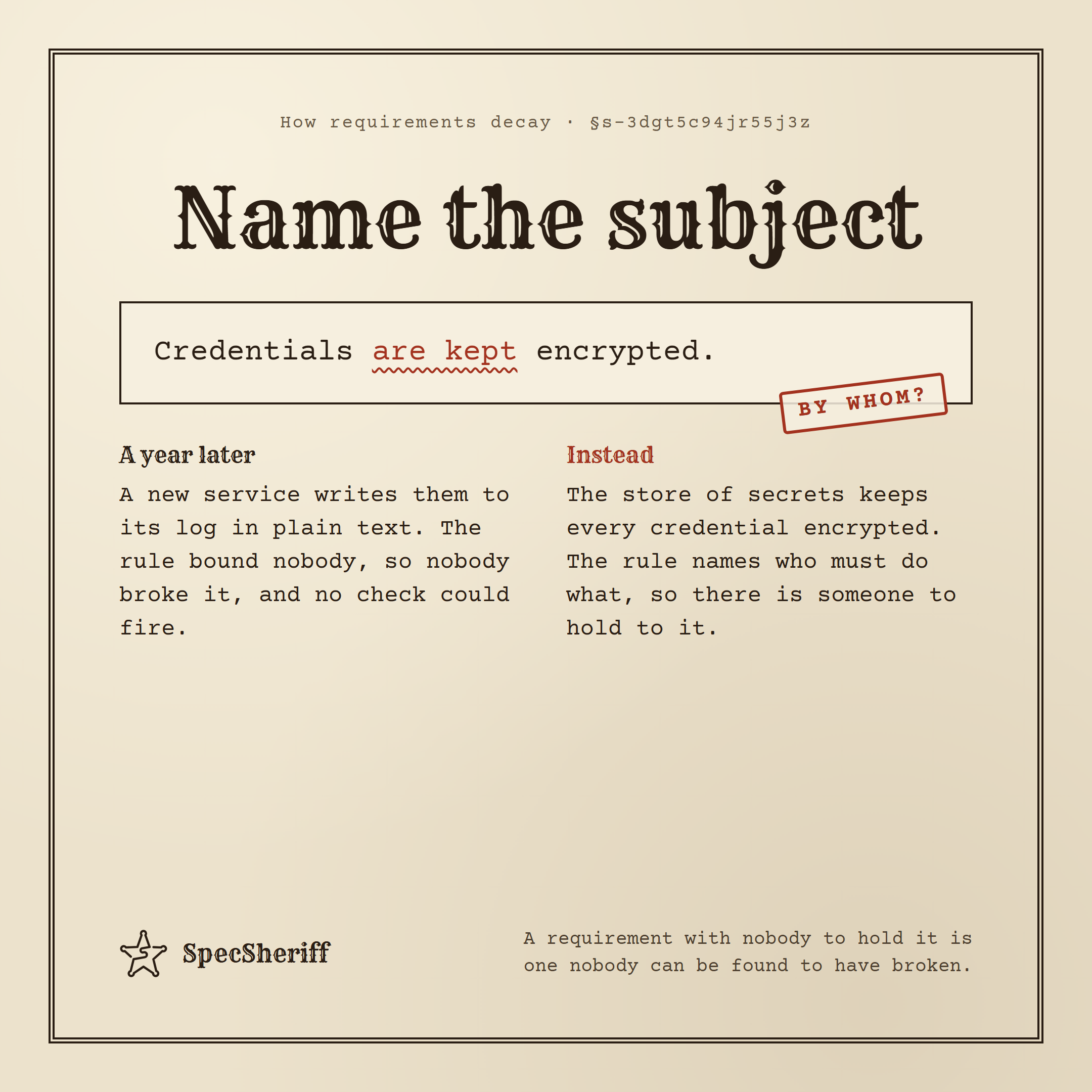
A rule names the subject it binds and states what that subject must do: not “credentials are kept encrypted”, which binds nobody, but “the store of secrets keeps every credential encrypted”. A property is stated over what the specification declares, never over what happens not to exist yet: not “a timestamp needs no time zone while every user is in one”, but “a timestamp carries its time zone”. A rule of the technical debt names its subject the same way and states what that subject does while the problem stands (§s-2r7k2aeyusgy6fw).
Such a sentence is true when it is written and silently false afterwards: nothing breaks, no check can fire, and the next reader takes an observation for an obligation. Naming the subject is also what makes a rule gradeable at all, since a requirement with nobody to hold it is one nobody can be found to have broken. A rule of the technical debt describes on purpose, and is removed with its problem (§s-2r7k2aeyusgy6fw).
The links it makes
The decisions taken on it
- Problem
A rule of the technical debt states what its subject does while a problem stands, which this rule's demand that a rule state what its subject must do did not admit.
- Ruling
Carried from the owner's ruling of the same day on the technical debt (§s-2r7k2aeyusgy6fw): the exception is written here, where the rule it narrows is read.
- Problem
Its examples were drawn from one project a reader of the method does not know.
- Ruling
The owner: the examples name what any system has — a user, an operator, a data record, a request — and nothing of one implementation; the worked example's subject stays in the example.